
CERVICON®-DIM
About the product
-
Brand name:
Cervikon®-DIM
-
Dosage form:
Vaginal suppositories
-
Composition:
1 suppository contains:
Active pharmaceutical substance: diindolylmethane – 100 mg.
Excipients: solid fat (1979,5 mg); crospovidon (20 mg); red carmine, Е 120 (0,5 mg).

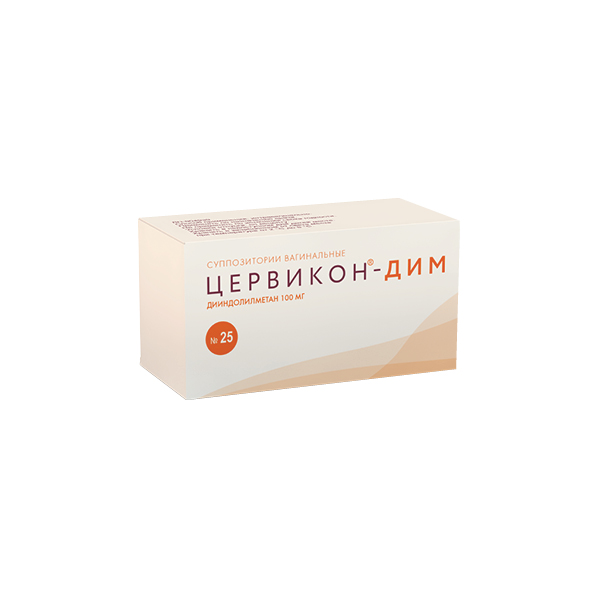
An innovative topical medicine for the cervical dysplasia treatment with targeted action against human papillomavirus infection.
Description
Suppositories range in color from light pink to yellowish-pink, torpedo-shaped, with a possible specific odor. A longitudinal section may show the presence of an air pocket and/or a funnel-shaped depression.
Indications
Indicated for use in adults. Treatment of cervical dysplasia (cervical intraepithelial neoplasia) of the cervix (regardless of the results of detecting papillomavirus infection by PCR method).
Dosage Regimen
Adults
100 mg intravaginally twice daily. The duration of treatment is 3–6 months. The duration of treatment is determined based on changes in clinical and laboratory parameters.
Children
The safety and efficacy of Cervicon-DIM in children aged 0 to 18 years have not been established. No data are available.
Method of Administration
The medicinal product should be administered intravaginally twice daily (morning and evening), 1 suppository at a time. Hands should be washed thoroughly immediately before administration. The suppository should be inserted deep into the vagina while lying down. The use of a sanitary pad is recommended after administration.
Counterindications
— Hypersensitivity to diindolylmethane or any of the excipients
— Pregnancy and breastfeeding
Adverse Reactions
Summary of the Safety Profile
Information on adverse reactions was obtained from clinical trials, post-marketing safety studies, and spontaneous reports for which a causal relationship between the medicinal product and the adverse event was considered reasonably possible and confirmed.
Adverse reactions reported during post-marketing use, for which a causal relationship with the medicinal product was considered possible, are marked with an asterisk (*).
The following adverse reactions may occur with intravaginal administration of CERVICON-DIM:
| Infections and infestations | |
| Common | asymptomatic bacteriuria¹1 |
| Uncommon | bacterial vaginosis¹1 |
| Blood and lymphatic system disorders | |
| Common | thrombocytopenia |
| Immune system disorders | |
| Common | urticaria, allergic pruritus |
| Gastrointestinal disorders | |
| Uncommon | diarrhea |
| Skin and subcutaneous tissue disorders | |
| Uncommon | petechiae; abnormal hair growth rate (slowed hair growth on the scalp and body) |
| Reproductive system and breast disorders | |
| Common | vulvovaginal discomfort, genital burning sensation, vulvovaginal pruritus, vaginal discharge |
| Uncommon | vulvovaginal dryness, delayed menstruation |
| Uncommon | edema of the female external genitalia*, vulvovaginal erythema* |
| Investigations | |
| Common | increased aspartate aminotransferase level; increased alanine aminotransferase level; increased erythrocyte sedimentation rate; white blood cells present in urine; protein present in urine; increased blood ketone body level |
| Uncommon | increased blood pressure; decreased blood creatinine level; abnormal vaginal smear results (leukocytosis in a cervical smear) |
Note: 1 – these adverse reactions were not associated with any corresponding clinical manifestations.
Pharmacological Properties
Pharmacotherapeutic Group
Other antineoplastic agents.
ATC code: L01XX
Mechanism of Action
CERVICON-DIM contains diindolylmethane as the active substance. Diindolylmethane stimulates apoptosis of human papillomavirus (HPV)-infected and transformed cells and stimulates the expression of γ-interferon receptors. Thus, the therapeutic effect of diindolylmethane is based on its ability to accelerate the elimination of HPV-infected and transformed cells and enhance the nonspecific immune response to infection.
In addition, diindolylmethane normalizes estradiol metabolism in HPV-infected cells, preventing the formation of the carcinogenic estrogen metabolite 16α-hydroxyestrone, which stimulates the expression of HPV oncogenes. By suppressing the expression of the human papillomavirus E7 oncogene, diindolylmethane blocks hormone-dependent pathological proliferation of HPV-infected cells.
 English
  Русский